
Proper long-term storage is not merely about putting a cordless drill battery away; it’s a deliberate protocol to preserve its electrochemical health and future performance. For 20V DeWalt MAX Lithium-ion power tool batteries, adhering to specific temperature and charge-level guidelines is the cornerstone of maximizing lifespan and ensuring safety during periods of inactivity. The following protocols are synthesized from official recommendations and fundamental lithium-ion battery science.
🔋 The Core Storage Protocol: Charge Level & Temperature
The two most critical, interdependent factors for battery preservation are the State of Charge (SOC) and the ambient storage temperature.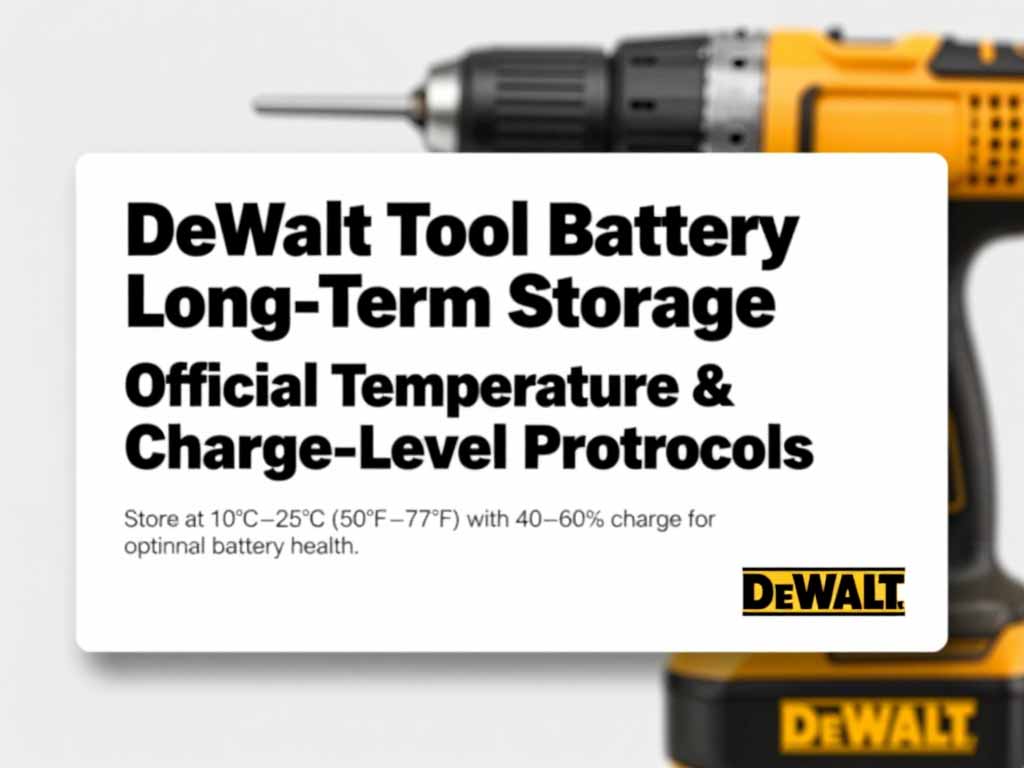
1. Official Charge-Level Recommendation For long-term storage, the universally recommended charge level for DeWalt 20V Lithium-ion batteries is a partial charge of approximately 40% to 50%. Storing the battery within this mid-range “sweet spot” is based on the fundamental chemistry of lithium-ion cells:
- Why 40-50%? This charge level minimizes electrochemical stress on the internal components. It significantly reduces the rate of self-discharge and capacity fade compared to storing at full voltage.
- What to Avoid: Never store a battery that is fully depleted (0%) or fully charged (100%). A fully depleted battery risks irreversible chemical damage, while a 100% charge keeps the cells under constant high voltage stress, accelerating degradation and permanent capacity loss.
2. Official Temperature & Environmental Guidelines The storage environment is equally vital. The official guidance emphasizes a controlled setting:
- Ideal Temperature Range: Store the battery in a cool, dry place within an ideal temperature range of 32°F to 77°F (0°C to 25°C). A broader permissible storage range is cited as 0°C to 45°C (32°F to 113°F), but for long-term health, the cooler end of this spectrum is strongly advised.
- Critical Environmental Don’ts: Avoid extreme temperatures entirely. Do not store Dewalt DE9094 tool batteries in locations prone to high heat (e.g., a car trunk, direct sunlight, or an unheated shed in summer) or freezing cold. Both extremes can cause rapid capacity loss and physical damage. The area should also be dry to prevent corrosion on the battery terminals.
📅 The Long-Term Storage Maintenance Schedule
Lithium-ion batteries slowly self-discharge even when not in use. Therefore, “set and forget” is not a viable strategy for storage exceeding a few months.
- The 3-Month Rule: For storage periods longer than three months, a maintenance routine is essential. It is recommended to check and recharge the battery every 3 months to top it back up to the recommended 40%-60% charge level. This prevents the pack from self-discharging to a critically low voltage, which can lead to permanent damage.
- Pre-Storage Preparation: Always remove the Dewalt DCB200 drill battery from the power tool before storage. Even when switched off, tools can draw a tiny “parasitic” current that, over months, could fully drain the battery.
By meticulously following these temperature and charge-level protocols, you transition from merely storing a battery to actively preserving it, ensuring it delivers full battery power and runtime when it’s time to return to work.