
A brand new quality replacement battery is safe for your Makita, Dewalt, Hitachi or Bosch power tool — provided it matches your tool’s voltage, uses the same form factor, and carries genuine protection circuitry (BMS), transport certification and a real warranty. You can typically save 40–50% versus OEM pricing, and most jobsite failures come from one mistake: buying on brand name alone instead of checking voltage and capacity.
Lithium-ion cordless drill batteries are rated for roughly 500–1,000 charge cycles — about 2 to 4 years of regular trade use. Heat is the killer: leaving batteries in a ute (or a hot shed) on a 40°C day accelerates cell degradation dramatically. When a battery drops below about 60% of its original runtime, the practical move is replacement — a new tool battery costs a fraction of a new tool, and most tools outlive several batteries.
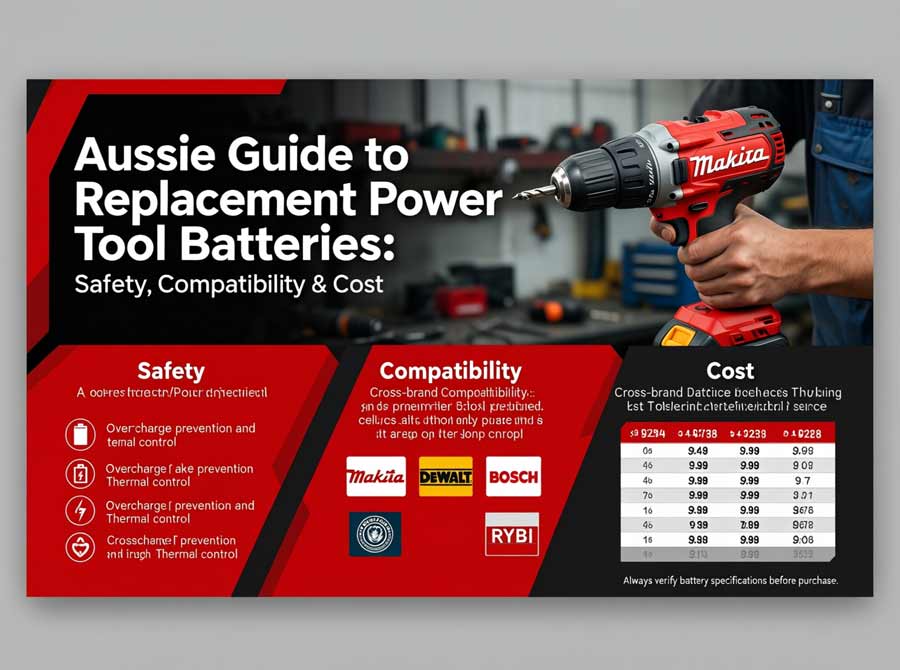
The Compatibility Check (3 Steps, 2 Minutes)
- Read the battery label. Every battery has a model number (e.g., Makita BL1860, DeWalt DCB184, Ryobi P108, Bosch BAT043). This is your search key — not the tool’s name.
- Match the voltage exactly. An 18V tool needs an 18V battery. A 54V (or 40V Max) platform is not interchangeable with 18V. Never “upgrade” voltage to make a tool run harder — you can damage the tool and the battery.
- Choose mAh by runtime needs, not bigger-is-better. Higher Ah (e.g., 5.0Ah vs 3.0Ah) = longer runtime and more weight. For a drill used intermittently, 3.0–4.0Ah is the sweet spot; for a circular saw or grinder, 5.0Ah+ pays for itself.
How to Tell a Safe Replacement Battery From a Dangerous One
This is the question every tradie asks — and it’s the right one. Four checks:
- Protection circuitry (BMS). A quality replacement battery has a Battery Management System that guards against overcharge, over-discharge, over-current and short circuit. If a product page doesn’t mention BMS, ask.
- Cells that are actually rated. Good replacements use branded cells (or cells from reputable C-rate suppliers) at the stated capacity. A suspiciously cheap “6.0Ah” battery that weighs like a 3.0Ah is usually a capacity lie.
- Transport certification. Lithium batteries must comply with UN38.3 for air freight. A supplier that can’t show transport documentation is a red flag for the cells inside.
- A real warranty and a real address. Buy from an Australian-based seller with an ABN and a physical warehouse. If something’s wrong, you want to deal with a local company — not a 3-week email loop to an overseas marketplace.