
Hitachi DS 18DFL drill still drives straight, the chuck is tight, the motor sounds healthy, and the gearbox shifts clean — the only thing that quit is the battery pack. Turn it over and the label reads BCL1815, which is how most owners end up searching for a replacement: not by tool model, but by the part number moulded into the old battery. That works in your favour. You do not need a new power tool, and you do not need OEM prices to get back on the tools. A high quality aftermarket replacement costs a fraction of a new kit and keeps the one you already own in service.
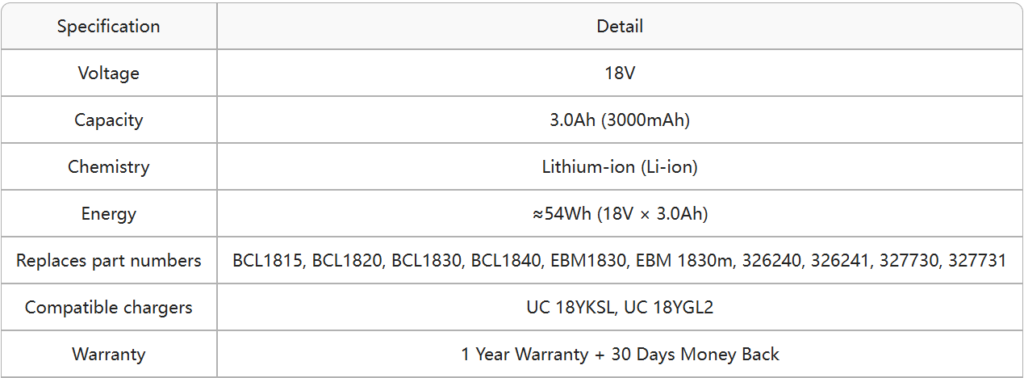
Hitachi BCL1815 battery replacement specifications
The pack is listed under model BSL1815/BCL1840 and is built to meet or exceed OEM specifications. It carries RoHS and CE certification, with protection circuitry against overcharge, over-discharge and over-current, plus a stable voltage circuit that supports fast charging.
The pack slides onto the same rail mount as the original, so it fits the legacy Hitachi 18V family directly — no adapters, no rewiring. Representative examples by tool type:
- Drill/drivers and hammer driver drills: DS 18DL, DS 18DFL, DS 18DMR, DV 18DL, DV 18DMR
- Impact drivers and impact wrenches: WH 18DL, WH 18DMR, WR 18DL, WR 18DMR
- Circular saws: C 18DL, C 18DLX, C 18DMR, C18DLP4
- Reciprocating saws and jig saws: CR 18DL, CR 18DMR, CJ 18DL
- Rotary hammers: DH 18DL, DH 18DLX
- Grinders and blowers: G 18DL, RB 18DL, UB 18DL
Charging and first use
Give the pack a full charge before first use. It is designed to work with original Hitachi chargers — the UC 18YKSL and UC 18YGL2 are the listed models — so the charger you already own is the one to keep using.
Hitachi’s manuals for these packs advise charging with the designated charger in roughly a 10–40°C ambient window. Outside that window the charger indicator blinks and charging waits rather than starting. That is normal protection behaviour, not a fault. In practice: if the pack is hot after a long run or a sit in a warm ute, let it cool in the shade before it goes on the charger. In winter, the reverse applies — a pack left overnight in a cold shed should warm up to something closer to room temperature before charging resumes.
One habit worth forming: do not park the pack on the charger indefinitely. Take it off when it is full. Holding cells at full charge around the clock is a known way to speed up ageing.
Maintenance and storage
Li-ion self-discharges slowly, but stored packs still drift down. Recharge roughly every 3 months when the pack sits unused, and store it cool and dry, away from heat sources and loose metal objects.
A few practical routines:
- Take the pack off the tool when the tool is idle. It prevents accidental startups and removes any standby drain.
- Clean the contacts now and then with a cotton bud and a little alcohol. Sawdust and grease on the rails raise resistance and heat.
- In an Australian summer, never leave packs on a ute tray or in a tin shed. Heat is the single biggest killer of Li-ion cells — a shed that hits 45°C will age a tool battery pack faster than a year of honest work.
Technical tips for more runtime and longer life
Partial discharges beat deep ones. Li-ion has no memory effect, so topping up at smoko costs nothing — swap packs when the tool starts to labour rather than running it flat.
The flip side matters just as much: when the tool cuts out, stop. Forcing a flat pack to keep driving stresses the cells and can permanently cost capacity. Put it on the charger instead.
On busy jobs, run two packs in rotation — one on the tool, one on charge. This pack’s stable voltage circuit supports fast charging, so a rotation keeps high-draw tools like the C 18DL circular saw or G 18DL grinder going through a full shift without waiting around.
Safety essentials
The short list, all worth following:
- Never disassemble or crush the pack.
- Never incinerate it or put it near open flame.
- Keep terminals away from keys, coins and other metal — a short across the contacts gets hot fast.
- Keep the Hitachi EBM1830 cordless tool battery pack dry.
- Keep it out of reach of children.
- Retire any pack with a cracked case, visible damage or swelling. Do not charge it; take it to a battery recycling drop-off.