
Your drill is fine. The old Ni-MH battery is the problem: it charges, holds power for an hour, then dies by the third screw. That’s just age, don’t replace the drill. A new Makita 1822 battery costs under $40 and brings your drill—plus every 18V Makita tool back to life.
Makita 1823 Tool Battery Specifications
| Feature | Detail |
|---|---|
| Voltage | 18V |
| Capacity | 3.0Ah / 3000mAh |
| Chemistry | Nickel-metal hydride (Ni-MH) |
| Energy | ≈54Wh (18V × 3.0Ah) |
| Replaces | 1822, 1823, 1833, 1834, PA18, 192828-1, 192829-9 and more |
| Warranty | 1 year, plus 30 days money back |
This is an aftermarket pack, not a genuine Makita product. It’s built to meet or exceed OEM specifications, carries CE and RoHS certification, and is tested to match OEM-style requirements. Protection circuitry guards against overcharge, over-discharge and over-current. The chemistry is Ni-MH, which means minimal memory effect: you can top it up whenever convenient without running it flat first.
Which tools does this battery fit?
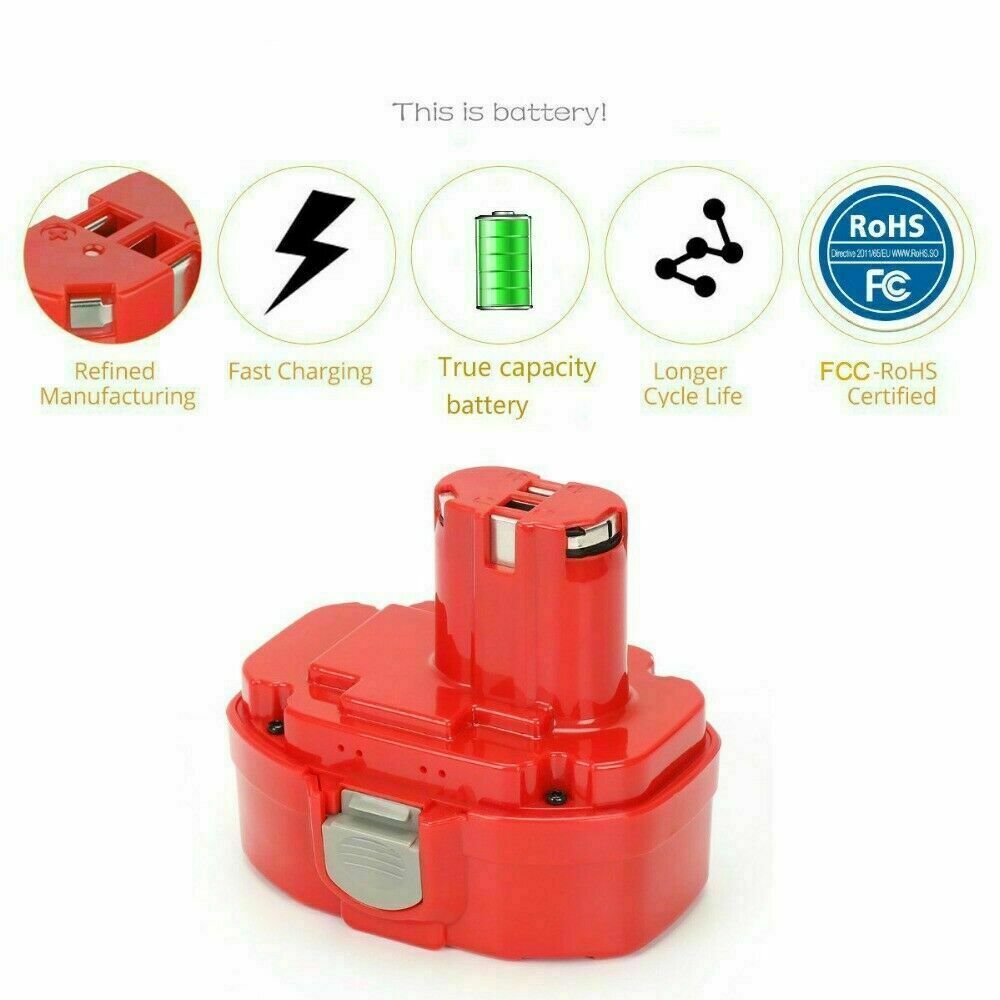 More than you might think. The 1822 is the entry point into Makita’s legacy 18V pod platform — one physical battery format shared across a large family of tools:
- Drills and drivers — 6343D, 6347D, 6391D, 8443D, 8444D, 8390D/8391D variants, 6936FD
- Saws — JR180D reciprocating saw, 4334D jigsaw, circular saws 5026D, 5036D, 5046D, 5620DWD and 5621D, slide mitre saws LS711D and LS800D
- Around the site — BMR100 site radio, ML183 torch, UB181D blower, SC190DWDE shears
The full compatibility list, including every replaced part number (1835, 1835F, 193061-8 and 193102-0 among them), is on the Makita 1822 replacement battery page.
Charging and first use
Give the pack a full charge before first use. Use the original-era Makita charger built for this pod platform — the same one that charged your old 1822 or PA18.
Charge at room temperature, roughly 10–30°C. If the pack has been baking in a ute tray or the charger lives in a hot shed, let everything cool down before you plug in. Hot Ni-MH cells accept charge poorly and degrade faster. And don’t leave the pack parked on the charger for days on end; Makita’s manuals for batteries of this type advise taking the pack off once charging is complete.
Makita tool battery maintenance and storage
Ni-MH packs self-discharge in storage. A charged pack left in the shed drifts down over a few months, so put it back on the charger roughly every three months.
A few other habits pay off:
- Take the pack out of the tool when it’s not in use. A switch bumped on, or slow drain through the tool’s electronics, can flatten a stored pack.
- Clean the contacts. Job-site dust and light oxidation add resistance. A cotton bud dampened with methylated spirits or isopropyl alcohol over the terminals — on both pack and tool — keeps the connection solid.
- Store cool and dry, away from heat sources and loose metal. Terminals meeting a key or a handful of screws is a short circuit waiting.
One specifically Australian point: a tin shed in January can sit above 45°C, and that kind of heat is hard on Ni-MH cells. Store packs inside the house or a cool workshop, and never charge them in a hot shed or tray in the middle of summer.
Technical tips for more runtime and longer life
- Prefer partial discharges. Ni-MH has little memory effect. Topping up at smoko does no harm; habitual deep drains do.
- Don’t force-run a flat pack. When the tool starts bogging down, that’s the pack telling you to stop. Swap it out and recharge instead of squeezing the last few seconds.
- Rotate two tool battery packs on busy jobs. One in the tool, one on the charger, each getting time to cool between cycles.
- Match the battery pack to the work. 3.0Ah is a good fit for drills, drivers, torches and radios. If you run circular saws or a reciprocating saw hard, the 4.8Ah 1835 version of this same pod carries around 60% more energy.